
How Do Festo Pneumatic Rotary Actuators Boost Automation?
Introduction
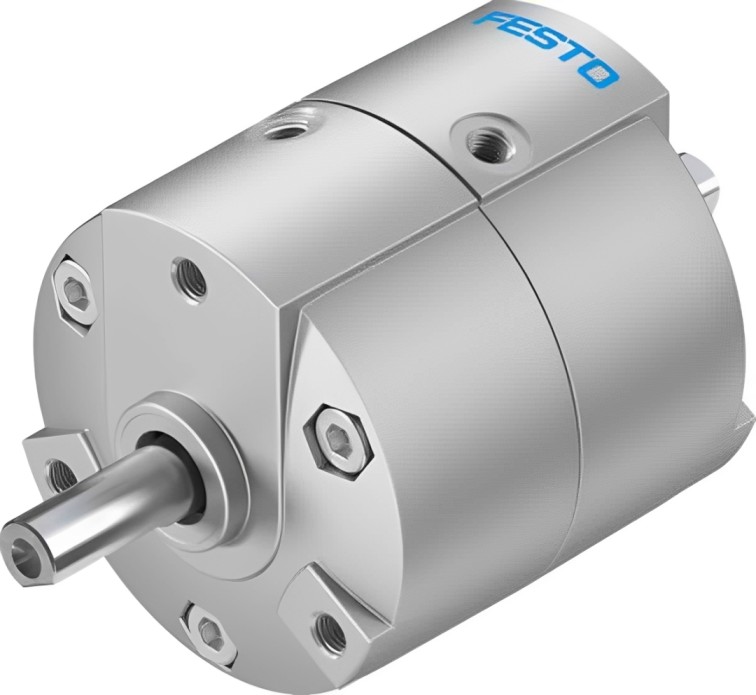
Modern automated machinery needs compact movement for turning, indexing, and positioning components. Festo Pneumatic Rotary Actuators meet this need by converting compressed air into controlled angular motion for assembly, packaging, handling, and testing equipment.
Festo offers rotary vane and rack-and-pinion designs, with selected models supporting swivel angles of up to 270 degrees. They also offer configurable cushioning, sensing, mounting, and position-control options.
What Makes Festo Rotary Actuators Different?
Instead of producing straight-line travel, a rotary actuator moves an output shaft or flange through a defined angle. Compressed air enters the actuator, moves its internal mechanism, and creates torque that turns the attached load.
Rotary vane models use pressure acting on a vane inside a chamber. They suit compact installations and straightforward swivelling duties. Rack-and-pinion models use pistons and toothed racks to rotate a pinion, providing strong load capacity and accurate end positions.
A complete motion system also depends on compatible control and monitoring equipment. The Automation & Control Gear category supports engineers building coordinated machine functions around the actuator.
Where Do Rotary Actuators Add Value?
Assembly and Component Orientation
Production cells often rotate a part before inspection, fastening, marking, or transfer. A rotary actuator can turn a fixture through a repeatable angle without the complexity of a continuous electric motor.
For reliable sequencing, Motion Control Sensors can monitor position, movement, or speed. Meanwhile, Photoelectric Sensors can detect whether a component has arrived before rotation begins.
Packaging and Sorting Equipment
Packaging machinery uses rotary motion for flap control, product diversion, indexing, lid positioning, and gripping assemblies. Pneumatic actuation provides quick response and simple integration where compressed air is already available.
The actuator should move only after the controller confirms that products, guards, and downstream mechanisms are correctly positioned. This coordinated timing reduces collisions and supports consistent production.
Inspection and Test Stations
A test fixture may rotate a component so cameras, probes, or gauges can examine different surfaces. Because the movement follows a defined angle, the same inspection positions can be repeated during every cycle.
Mechanical confirmation devices and Limit Switch Accessories can support suitable end-position arrangements elsewhere in the machine. Designers should select components approved for the intended sensing method and environment.
How Should Torque and Rotation Be Selected?
Torque must overcome the load, friction, acceleration forces, and external resistance. The required value also depends on how far the mass sits from the shaft because a larger distance increases rotational inertia.
Engineers should compare:
- Required swivel angle
- Load mass and centre of gravity
- Starting and running torque
- Permissible mass moment of inertia
- Target cycle time
- Available supply pressure
- Required stopping accuracy
- Cushioning capacity
An undersized actuator may rotate slowly or fail to reach its end position. In contrast, an oversized model can increase air consumption and produce unnecessary impact unless speed and cushioning are controlled.
Why Are Cushioning and End Stops Important?
As a rotating load reaches its final position, it still carries kinetic energy. Cushioning slows the mechanism before impact, while mechanical stops establish the final angle.
Selected Festo series offer adjustable angles, fixed metal stops, hydraulic cushioning, or modular intermediate-position functions. The correct choice depends on speed, inertia, accuracy, and cycle frequency.
Reliable power also supports valves, sensors, controllers, and indication devices. Embedded Switch Mode Power Supplies (SMPS) can provide regulated DC power for compatible automation equipment.
How Do Electrical Connections Support Rotary Motion?
Although compressed air creates movement, electrical signals usually command and confirm each cycle. A controller energises the valve, receives sensor feedback, and determines when the next machine action begins.
Protected cable entry is essential inside cabinets and equipment housings. Cable Glands can secure cables and provide strain relief, while Cable Assemblies can simplify repeatable connections between compatible devices.
Signal and power wiring should remain protected from sharp edges, hot surfaces, and moving mechanisms. Good cable routing also reduces electrical interference and makes maintenance easier.
How Can Data Improve Actuator Performance?
Connected machines use sensor data to track cycle completion, position consistency, and unusual behaviour. When feedback reaches the control system quickly, operators can identify slow movement, missed positions, or developing mechanical resistance.
The Network And Communication Cable category supports data connections across controllers, industrial networks, and monitoring equipment. Selection should consider protocol, shielding, bend requirements, and environmental exposure.
Accurate feedback can support preventive maintenance, but it depends on correct sensor mounting, stable power, secure connections, and suitable control programming.
What Should Be Checked During Installation?
Before installation, isolate electrical supplies and depressurise the air system. Mount the actuator on a rigid surface and align the driven load with its output shaft or flange.
Important installation checks include:
- Confirm the intended rotation direction
- Verify clearance around the moving load
- Use the specified mounting hardware
- Avoid excessive radial and axial loading
- Route cables away from moving parts
- Set speed gradually during commissioning
- Adjust cushioning for controlled stopping
- Test every sensor and interlock
Local controls may also support setup or maintenance. Push Button Complete Units can provide start, stop, reset, or jog functions within a properly designed control system.
How Can Reliability Be Maintained?
Routine inspection should cover the actuator body, shaft, fasteners, tubing, cables, sensors, stops, and cushioning. Technicians should investigate leakage, impact noise, irregular speed, or changes in stopping position promptly.
The Electrical Cables & Wires category supports maintenance where damaged or unsuitable conductors need replacement. Always match voltage, current, flexibility, insulation, and environmental ratings to the application.
Clean compressed air, stable pressure, correct alignment, and controlled speed improve service life. Operators should also keep the actuator within its stated torque, inertia, pressure, and temperature limits.
Why Choose Festo Pneumatic Rotary Actuators?
Festo Pneumatic Rotary Actuators provide compact angular movement for machinery that must turn, index, orient, or transfer loads. Their vane and rack-and-pinion technologies support different torque, accuracy, cushioning, and space requirements.
By combining correct actuator sizing with dependable sensing, protected wiring, suitable control equipment, and careful commissioning, engineers can create an efficient rotary motion system that performs consistently across demanding automation cycles.