

How Can Solvents for Spectroscopic Applications Improve Analytical Accuracy?
Why Does the Right Spectroscopy Solvent Matter?
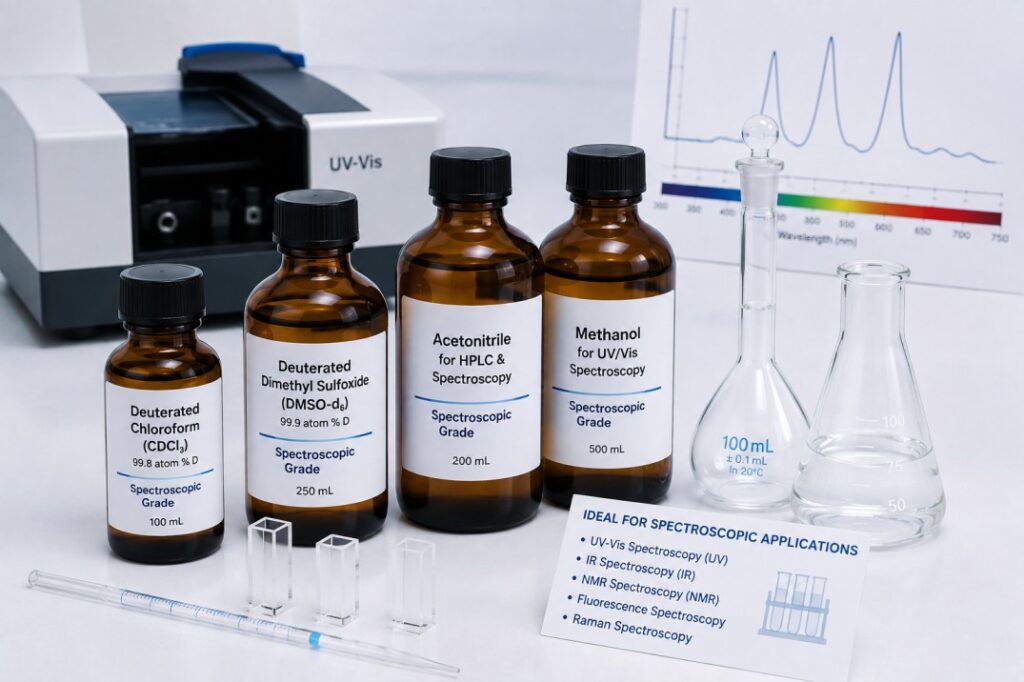
Products within Solvents for spectroscopic applications support analytical workflows where solvent quality can directly influence spectral clarity, background response and measurement repeatability.
In techniques such as UV/Vis, fluorescence, infrared and NMR spectroscopy, the solvent becomes part of the measurement system. It must dissolve the sample effectively while creating as little unwanted interference as possible within the analytical region being studied.
Choosing the correct solvent can therefore help laboratories produce cleaner spectra and more reliable comparisons between samples.
What Makes a Solvent Suitable for Spectroscopic Analysis?
A spectroscopy solvent should match both the sample chemistry and the measurement technique.
Important selection factors include:
- High chemical purity
- Low levels of interfering impurities
- Suitable optical transparency
- Good analyte solubility
- Chemical compatibility
- Appropriate water content
- Stable composition during analysis
- Compatibility with sample cells
The most suitable solvent is not simply the one that dissolves the analyte fastest. Its own spectral properties must also be considered.
How Does Solvent Purity Affect Spectroscopy Results?
Contaminants can introduce unwanted absorbance, fluorescence or other background signals.
This can become especially important when analysing low-concentration samples because even small impurities may contribute noticeably to the measured response.
Possible signs of solvent contamination include:
- Unexpected peaks
- Increased baseline absorbance
- Unstable background
- Poor reproducibility
- Unusual sample colour
- Differences between solvent batches
Using clean transfer equipment and keeping solvent containers properly closed can help maintain analytical quality after opening.
Why Is a Solvent Blank Used in Spectroscopic Analysis?
A solvent blank helps establish the background generated by the solvent and sample cell.
The blank should normally contain the same solvent system used to prepare the analytical sample but without the analyte of interest.
This allows the measurement system to distinguish the sample response from background contributions.
For consistent blank correction:
- Use the same solvent batch where practical
- Use comparable sample cells
- Maintain the same solvent composition
- Avoid contamination
- Follow the same preparation procedure
Poor blank preparation can make an otherwise accurate instrument produce misleading results.
How Should Samples Be Diluted for Spectroscopy?
Sample concentration should fall within the working range of the analytical method.
A solution that is too concentrated may produce excessive absorbance, while an overly dilute sample may generate a weak signal.
Suitable Microlitre Pipettes can support controlled preparation of small-volume dilutions when their operating range and calibration meet the method requirements.
Good dilution practice includes:
- Calculating the required dilution before preparation
- Using calibrated equipment
- Mixing after dilution
- Avoiding unnecessary solvent evaporation
- Recording dilution factors
- Preparing standards consistently
Accurate dilution is particularly important when spectroscopy is being used for quantitative analysis.
Which Cuvettes Can Be Used for Routine Spectroscopy?
Cuvette choice should match the solvent, wavelength and analytical method.
Suitable Single-Use Cuvettes can provide a convenient option for compatible routine measurements where their material offers the required optical range and solvent resistance.
Before selecting a cuvette, laboratories should consider:
- Measurement wavelength
- Path length
- Solvent compatibility
- Required sample volume
- Optical clarity
- Disposable or reusable requirements
Not every plastic or glass cell is suitable for every wavelength or organic solvent.
Why Does Cuvette Orientation Matter?
Consistent cell positioning helps reduce measurement variation.
Differences in optical surfaces, fingerprints, scratches or liquid level can influence the light passing through the sample.
For better reproducibility:
- Handle optical surfaces carefully
- Keep the outside clean
- Use a consistent orientation
- Avoid bubbles
- Maintain sufficient sample volume
- Check for visible damage
The blank and analytical samples should be handled in the same way whenever possible.
How Are Solvents Used in Fluorescence Spectroscopy?
Fluorescence measurements can be particularly sensitive to impurities because some contaminants may fluoresce even at very low concentrations.
Suitable Fluorescence Cells can support fluorescence measurements when matched correctly to the wavelength range, solvent and instrument.
When preparing fluorescence samples, consider:
- Solvent background fluorescence
- Sample concentration
- Excitation wavelength
- Emission wavelength
- Cell cleanliness
- Light sensitivity
- Contamination control
A solvent that appears acceptable in another analytical method may still create unwanted fluorescence background.
Can Solvent Choice Change the Spectrum of a Compound?
Yes. The chemical environment around an analyte can influence its measured spectrum.
Solvent polarity, hydrogen bonding, pH and other interactions may affect the position, intensity or shape of spectral features.
This means results obtained in different solvents may not always be directly comparable.
For meaningful comparisons, laboratories should keep key conditions consistent, including:
- Solvent identity
- Solvent composition
- Sample concentration
- Temperature
- Analytical wavelength
- Instrument settings
Changing one variable at a time makes spectral differences easier to interpret.
Why Is Water Content Important in Spectroscopy Solvents?
Water can influence some samples and spectroscopic techniques.
It may affect:
- Analyte solubility
- Chemical stability
- Hydrogen bonding
- Spectral background
- Reaction-sensitive compounds
- Reproducibility
Where moisture is critical, solvent handling should minimise unnecessary exposure to humid air.
The required solvent specification should follow the analytical method rather than assuming the driest available solvent is always necessary.
How Should Prepared Spectroscopy Samples Be Stored?
Prepared samples should ideally be analysed according to the timing defined by the method.
When temporary storage is required, suitable Autosampler Vials and Sample Bottles can support organised sample handling where their material and closure system are compatible with the solvent.
Stored samples should remain clearly identified with information such as:
- Sample name
- Solvent
- Concentration
- Preparation date
- Dilution factor
- Batch or reference number
Volatile solvents may change sample concentration if containers are not sealed effectively.
How Can Solvent Evaporation Affect Analytical Results?
Evaporation can increase analyte concentration by reducing the amount of solvent present.
Even relatively small volume changes can matter when precise quantitative measurements are required.
To reduce this risk:
- Keep containers closed
- Prepare samples close to analysis time
- Limit unnecessary transfer
- Avoid prolonged open-vessel storage
- Use suitable closures
Consistent handling helps ensure that the concentration measured is the concentration originally prepared.
What Causes Poor Reproducibility in Spectroscopic Measurements?
Solvent quality is only one potential source of variation.
Poor repeatability can also result from:
- Inaccurate dilution
- Different solvent batches
- Contaminated cells
- Inconsistent blank preparation
- Evaporation
- Bubbles in the sample
- Incorrect cell orientation
- Temperature variation
- Sample degradation
A structured troubleshooting process should examine sample preparation before assuming the instrument itself is responsible.
What Should Be Recorded in a Spectroscopy Workflow?
Good documentation strengthens analytical traceability.
Useful records include:
- Solvent identity and grade
- Solvent batch
- Sample concentration
- Dilution factor
- Preparation date
- Cell type
- Path length
- Measurement conditions
- Blank preparation
- Operator details
This information makes it easier to reproduce successful measurements and investigate unexpected spectra.
Conclusion
Solvents for spectroscopic applications are essential to reliable analytical measurements because solvent purity, optical behaviour and chemical compatibility can directly affect spectral quality.
Accurate results depend on more than simply selecting a high-purity solvent. Laboratories should also control dilution, blank preparation, cuvette selection, evaporation, fluorescence background and sample storage.
By combining suitable spectroscopy solvents with calibrated microlitre pipettes, compatible single-use or fluorescence cells, and well-controlled sample containers, laboratories can improve spectral consistency, reduce unwanted interference and produce more dependable analytical data.